
Twin Hearts: ~ suspended or held in abeyance
I write because I am inspired to do so. The English word and its derivatives are based upon the Latin inspirare, meaning “to breathe into”. No gain, award or commendation is required. It is my pleasure and one of my many passions, still, even at this crotchety ole age. This somewhat low-tech description below may not be purrfectly palatable, but, if you see all life (“Matter that chooses” ~ Lynn Margulis (1938-2011) as connected, intertwined and entangled, that humans and all else are part of nature, which is a divine creation, then read on, please.

A while back, I was scrolling through the net for a gif, when I came across this drawing, created in 2022.
There was no attribution for it. This site is firmly free in the public domain. I decided to strap on the ole glue apron and make a wall hanging, as I needed a project to wean myself from the coming winter doldrums. 33 hours later, I fashioned this from scraps, to suspend over my infernal terminal. I still prefer the desktop with its 23” monitor. No 3” mobile screens for this elder adult.

THE Technical Construction
I had some seat cutouts left over from the Cosmos and the Dragonfly series of 6 benches (to be posted later). Those were the scraps, but they were too thin, so I book-matched the halves and glued them together.
I went to Staples to get this blown up since the 4” drawing needed to be expanded to 36”. They would not do it. Next stop was next door at the Wally. They wanted $36 to enlarge the line drawing, but not today, sir. Nyet! Lastly, I went to a frame shop. They could only offer to print it on glossy paper for the princely sum of $86 + tax. I had some graph paper. A friend said, “Lay it out”, so I did. Thanks, Hilda.

Once the original drawing had been created, I looked at it and made a valiant effort to make it my own by shrinking this curve and expanding that one. I kept much of the primary intent. I then divided the drawing into two parts, as it would be far too flimsy in its rough form for one long unfinished design.
After gluing the component parts together under the tracing template, the two halves were cut out using a bandsaw and jigsaw. I began to smooth out the curve edges and refine the shapes. I only work in the afternoons, between 2-4 hrs/da.

The next step was to begin the texturing or chip carving with an 8 mm Swiss Made gouge I had purchased after a trip to Woodcraft Supply Corp., in Woburn, MA, in 1973, long before Lee Valley Tools was a gleam in Leonard Lee’s eye. Yes, I need my tools, and they need me. It is indeed a symbiotic relationship. One must cut with the grain, so even though pieces are chosen as best as possible for orientation and colour, often when using offcuts, some cannot be employed.

Care is taken not to cause chipping or roughness. There’s an old story of a Japanese carpenter who sharpened his plane for each final cut on the post and beam style construction that was ever popular in traditional circles. I have some Japanese saws that cut on the pull stroke. Far more precise than Western push cut saws. Of late, I have taken to stropping my chisels and kitchen knives. Incredible control and pleasure in the using. Strops and the companion green buffing compound are inexpensive.

strop
The next step was to choose some accents. Long ago, I brought these small ideas into my practice. I had a little Gabon ebony, the blackest there is. I also had a few offcuts of NS bird’s eye maple for the cleft and the lower apex. Maple and cherry contrast beautifully and are a historic tradition among cabinetmakers and furniture designers north of the 49th. The very first kitchen cabinet doors I made, consisted of maple frames with black cherry panels (1975). Cherry is called black cherry, because it is the only dark wood that darkens. Light woods darken, and dark woods lighten. It’s the oxidation process behind the scenes.

I knew, using end grain for some of the sections as they were all that remained, that the overall design was terribly fragile. I went to town and bought a partial sheet of 1/4“ Luan (Philippine) mahogany. After carefully reducing the width all ’round the design, I cut it out, rounded both edges, sanded it smooth and used some black dye left over from Goudey’s in Etobicoke, ON-Terrible. (allowed by expats only)

The ebony became arrows, so yes, I stuck myself a few times, since while the wood is very hard, it is also quite short-grained, breaking easily when in a diminutive size. Under the skin, it is toxic, with a splinter festering mightily overnight. As dust, it can make sensitive nasal linings bleed. Ask me how I know? hahaha

Those arrows can then be polished on a buffing wheel with the green compound to a high shine. The black residue will not discolour an already black wood. Wipe off the green residual compound, though.

I then cut the grooves of 5 mm with a laminate trimmer and a new straight bit. This is how “custom anything as long as it’s wood” becomes a gleam in my mind’s eye. Oftentimes, tools must be purchased for new work. That cost needs to become part of the price in this consumption economy.

My motto in 1973 was: “Custom anything as long as it’s wood”
The MOP (Mother of Pearl) dots are 1.5 and 3 mm, respectively. A taper-point drill bit is used both on a floor-standing drill press and a battery op hand drill.

Shallow depressions of 12 mm are drilled in the bird’s eye maple for the gold tiger-eye cabochons. It’s all accent or embellishment. Of course, to the astute, the design begs far more, as I will explain if you’ve read down this far. Many of these odd parts are purchased on Etsy or Ebay, where sellers abound in this arcane world of semi-precious polished stone and shell.

I used abalone shell for the “division” between the two hearts. I did not get a good fit, so some découpage was in order. Carpenters use mouldings and cabinet makers use inlay to conceal their faux pas.
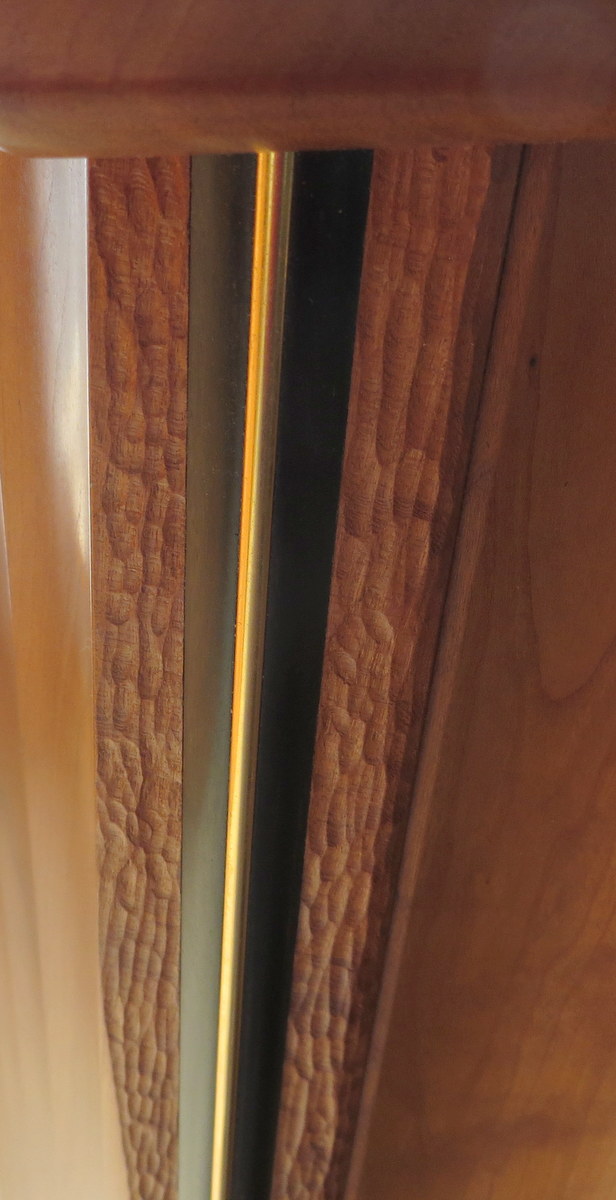
I first began using chip carving to embellish my work in 1985 with the Waveform loudspeakers. This was carried out front and back, on all four corners. The inlay is Gabon ebony, the blackest, with metal inlay, 23-5K gold plating. The backdrop was cherry wood.
Cherry, ebony, gold: The Waveform Loudspeaker [1985]
Enter abalone shell. The trouble is that the flat tiles, originally waste from a backsplash I purchased from a friend, do not lend themselves to bending. hahaha

[2025]
There is an interplay in the right light between the flat or polished areas and the sloped or chip-carved ones. This reflects the Yin/Yang nature of existence, the dark and the light. The perpetual change of perceived phenomena through our sensory evidence as our truth, as with The Universe’s only constant, i.e., change.
I’ve been chip carving my work for four decades as a form of texturing, in other words, to introduce another subtle design element into a piece, that normally might simply be sanded to a very fine degree, usually 320 grit, then polished, oiled, sometimes waxed, then delivered or hung on a wall. Next… 🙂

White ash mirror frame. [1989]
As I continued on with that form of minor embellishment to this twin hearts design, once the theme of this piece began to unfold, I realized something my gut has been telling me for years. Allow me a slight divergence, please. Ever wonder why the Buddhist religion and its devotees focus so suffering so much? That’s our material reality, our lot here in this plane on E-air-th.

BC white cedar screen in a Japanese shoji motif. [2021]
However, there are a few simple joys, pleasures and profound insights we receive from bestowal by The Universe. It is my view, that despite the lesser quantity of the good, those positive attributes far outweigh and overshadow all the pain, suffering and negativity. This is what drives people like me to create in whatever medium has been our lifelong choice.

Walnut bed shelf motif [1989]
Gluing and nailing the support plywood to the back with 1/2″ finishing brads was next. Then came the finishing oil, polymerized (heat-treated to add hardness and for drying faster) tung oil (from a Chinese tree nut). One coat is sufficient since I polished the inlay areas with 1200 grit, with the balance of the cherry needing only 320 grit.

Suspended walnut night table. Sun’s expansive rays passing through the E-air-th ring on a bride’s finger. [1989]
When one uses any oil, the sheen is mostly dependent upon how much material remains on the surface. The rubbing off of excess is also a polishing step.

Lastly, the hanging wire was added. I had some transparent thin fishing line. As I look at it, I may change that to a hole for a screw so that no visible wall attachment can be detected. Yes, a small point. Isn’t that what craftsmanship means? It’s not striving for perfection; it’s allowing excellence to reign as champion.

THE Spiritual Explanation
As I build things, I let my imagination run wild. In the first case, one can imagine that the two hearts were meant to resemble a Western style romantic entanglement by two lovers. Fair enough; a design requires an entry point. However, to me and others, this is the nature of the Cosmos; Yin and Yang, light & dark, love ‘n hate.

The white line becomes the area of entry and exit from one realm to ‘nother. The 3 mm MOP dots represent the stars of The Universe — pure energy. The 1.5 mm white, black, gold and NZ Pāua shell are their planets, abiding within infinite multiplicity. The circular, spiral and elliptical curves are representative of galaxies in orbit. Some collisions are inevitable and time dependent.
There is even a black hole vortex. When I came in one morning, I used the compressor to blow off the shell dust (again, I needed to purchase a diamond file as ordinary wood files will blunt in short order, making them useless for other work).

Cherry bench with ebony inlay [2025]
I saw that one of the 3 mm gold MOP holes was blank. YIKES! Was I going to order another package or two or three to get free shipping? No! The mother of invention is necessity. I took some ebony dust, mixed in a spot of white glue and pasted that concoction into the hole. Eh voilà! We have a black whole. hahaha

The arrows are going ‘every which way but loose.’ Thanks, Clint. They bring in the love and also release it back into the Cosmos for circulation. If you have an excess of anything, give it away. That’s LAW! That generosity must supplant the personal profit motive to end this rapacious economic paradigm of capitalism, colonialism and imperialism. These are male ideas, whose usefulness has reached a decisive conclusion by endangering life as we know it. Yes, I’m a deep ecological anarchist at heart.

[2024]
To sum up, people sea what they want to in a design. I’m well aware that “beauty is in the eye of the beholder”. That’s choice, governed by tradition, personal taste and contemporary custom. My shtick has always been to balance inline with outline. To use colour and grain to the best advantage of the design for its own sake, then let the slings and arrows land where they may. I really appreciate JK’s (Jiddu Krishnamurti) odd assertion. When asked why he was always so happy, even though he rarely smiled, his answer was usually the same: “I don’t mind what happens”.
twin hearts [2025]